Noticed signs of damp and mould in your home? Find out more here and contact us as soon as possible.

In April 2026, your rent and charges amounts will change. Most rents will go up by 4.8%, please check your individual rent letter for your new amount and what the increase means for you.

Each year, we’ll give you at least four weeks’ notice of the rent increase, depending on your tenancy type. Letters are posted late February to allow for this, but please let us know if you don’t receive your letter.

2026 rent change dates:

  • Monthly tenancies: changes applied from 1st April 2026
  • Weekly tenancies: changes applied from 6th April 2026

This page explains about how we calculate rent increases, how the money you pay us in rent is used, and the support available to you if you’re finding it difficult to keep up with your rent payments.

Why we need to increase your rent

As a non-profit organisation, the money you pay in rent is reinvested in our homes and services.

As with most other day to day expenses, the costs to provide our services have risen significantly. When we review rents and make a decision about rent increases, we work hard to find a balance between keeping rent affordable and making sure we can continue to:

  • Carry out day to day repairs on your home
  • Keep your home and neighbourhood safe and well maintained.
  • Meet regulatory requirements, like the new Awaab’s Law for responding to reports of damp and mould.
  • Deliver the extra services you rely on, like our Moneywise and employment support.
  • Invest in long term improvements to keep your home and neighbourhood clean, safe and fit for the future, such as replacing bathrooms, kitchens and roofs.

In March last year, we were inspected by the Regulator of Social Housing and were awarded the highest grading for the new consumer standard, C1. They also confirmed we retained our previous gradings for their governance standard, G1, and viability standard, V2. It confirms we are on track with the work and commitments set out in our current three-year plan, Delivering What Matters, and that we are working at the right pace to deliver the services you need, in the way that you need them.

How we use your rent

We prioritise being open and accountable as we work hard to be a landlord you can trust. That’s why we’re transparent about how we use the money you pay us in rent. Every penny and pound is spent wisely to improve your home and our services to you and your community.

When rent is paid on time and arrears are reduced, it helps towards our work in keeping our communities sustainable and great places to live. Rent income allows us to maintain and carry out repairs to your homes, meet regulatory standards for health and safety, invest in improvements, provide our extra services like Moneywise, our Employment support and our Brighter Community Fund where we invest in neighbourhoods.
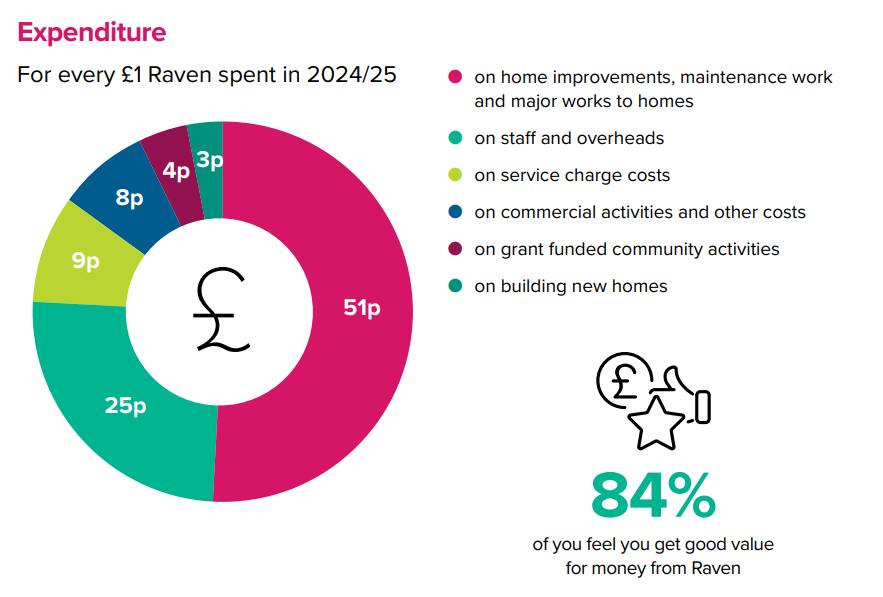
Raven's expenditure for 2024/25

When we review rents and service charges our aim is to strike the right balance between covering the costs of providing the services you want and need, and the impact the increase has on you.

As we’re a registered social housing provider, we follow rules set out by the Regulator of Social Housing for most of our rents. These rules ensure that rents are kept fair and affordable.

The formula we adhere to for increasing rents the majority of our rents is Consumer Price Index (CPI), also known as inflation, plus 1%. The inflation rate in September each year is used for this calculation. The CPI in September 2025 was 3.8%, plus 1% gives us the rent increase of 4.8% from April 2026.

As well as this formula, there are caps, or maximum rents for each type of property and area. Depending on when your home was built and how it was funded, rents can vary from around 50-60% of local market rents (known as social rents), to around 80% of local market rents (known as affordable or sub-market rents). Your tenancy agreement and rent increase letter will explain which type of rent you have.

Social and Affordable rents

If you’ve got a Social or Affordable rent type, your rent is governed by the Rent Standard. The Regulator of Social Housing decides how these rents should be set and we must comply than this. The limit to rent increase is CPI plus 1%, as explained above.

Any part of your rent and charges that include fixed service charges will also increase by the same amount as your rent, this covers the cost of providing these services. In some cases, the annual rent increase would mean that your new affordable rent amount would be more than the Local Housing Allowance limit for your area (Housing Benefit limit). We choose to cap your rent at the Local Housing Allowance limit to keep it affordable. If you have an Affordable Rent type and notice that the increase is less than 4.8%, this is why. Please note, this does not always apply to properties we manage for other organisations, like Habitare.

You can check the Local Housing Allowance rate for your area here.

Fair Rent

Standard and is also Protected Rent registered with the Valuation Office Agency. This means that if your rent increase would take your charge above either the Social Rent Cap or the last registered Fair Rent level, we have capped it at whichever is lowest. Any element of your rent and charges that covers services will also increase by the same amount as your rent, to reflect the cost of providing these services. The only exception to this is variable service charges, such as water or heating, as these may go up or down dependant on actual costs.

Exemptions from the Rent Standard

If you have a Key Worker or Intermediate rent type, or you live in one of our Temporary Accommodation homes, these are not included in the Regulator of Social Housing’s Rent Standard. However, to help with affordability, we choose to only increase rents by the same percentage as those that are covered in the Rent Standard.

So this year, rent amounts for these properties will also be increased by 4.8%. Any element of your rent and charges that covers services will also increase by the same amount as your rent, to reflect the cost of providing these services. The only exception to this is variable service charges, such as water or heating, as these may go up or down dependant on actual costs.

Most tenancies are charged rent 52 weeks of the year. Some homes that originally transferred from Reigate and Banstead Borough Council are charged for 48 weeks of the year and have four rent free weeks.

The total annual charge is the same for similar homes at social rents, just split over 48 instead of 52 weeks. If you pay monthly, your monthly rent will already have your rent free weeks factored into your payments.

The remaining rent free weeks for the 2025-26 financial year are:

  • Week commencing 23rd March 2026
  • Week commencing 30th March 2026

The rent free weeks over the 2026-27 financial year are:

  • Week commencing 28th December 2026
  • Week commencing 4th January 2027
  • Week commencing 22nd March 2027
  • Week commencing 29th March 2027

What do I need to do for the April 2026 rent increase?

What you have to do next depends on how you pay your rent and whether you receive benefits to support your rent payments.

If you receive Universal Credit you must update your online journal with your new rent and charges from the date your rent increases. Universal Credit won’t accept any updates in advance, so don’t update your online journal before these dates:

  • If you’re charged monthly, update your online journal from 1st April.
  • If you’re charged weekly, update your online journal from 6th April.

If you don’t update your online journal on time, you could miss out on money you’re entitled to.

If you receive Housing Benefit, you need to let your local authority know your new rent amount. We recommend letting them know as soon as possible, you don’t need to wait until April to do this.

If you’re with Reigate and Banstead Borough Council and they pay your Housing Benefit directly to us, we’ll let them know for you. However, if you receive Housing Benefit payments paid to yourself, you need to notify them of your new rent and service charge.

Don’t forget to update your payments to your new charges before your first payment is due. If you pay by Standing Order, you may need to contact your bank.

If you have a repayment plan with us to pay your rent plus an amount off any arrears and you don’t pay by Direct Debit or Recurring Card Payment, you’ll need to adjust your payments to take into account these changes. It’s important that you continue to maintain your repayment plan.

If you pay by Direct Debit or Recurring Card Payment, your payments will be automatically amended to reflect your new charges. We’ll let you know what your new payments will be before we start taking them out of your account.

Frequently asked questions

Talk to your Income Officer

If you’re finding things difficult, it’s always best to talk to us so that we’re aware of your circumstances and can offer the right support. Your Income Officer is at the end of the phone or you can request contact on MyRaven if you’d prefer to email.

Moneywise team

Let us know as soon as possible if you need support with budgeting, applying for benefits, benefit appeals or advice on reducing your bills. We’re here to help. This advice is free and confidential for all Raven customers.

Customer Support Fund

We know the increase in cost of living means it’s a really challenging time and so our Customer Support Fund is here to help. Our Moneywise team can work with you on an application to the fund that can be used to support with unexpected and emergency costs such as energy bills, furniture, appliances, or other debts or outgoings you may be struggling with. The fund is available to all customers including if you’re employed, not receiving benefits, in sheltered or temporary accommodation.

No, the total is still 4.8% for rent and fixed service charges. If you have any variable service charges, for example for personal or block heating, these may go up or down at a different rate depending on actual use.

There are a small number of tenancies where a 4.8% increase would be over either the government’s rent cap for regulated rents or one of our caps here at Raven. This is explained in your rent increase letter, if it applies to you.

Rent and fixed service charges have been set at 4.8%. If you have variable charges, for example personal or block heating, these may go up or down at a different rate as they’re based on actual use.

Need further support with your rent increase?

Call: 0300 123 3399
Email: raven@ravenht.org.uk
Send us a message through your MyRaven online account

Cookie Settings